
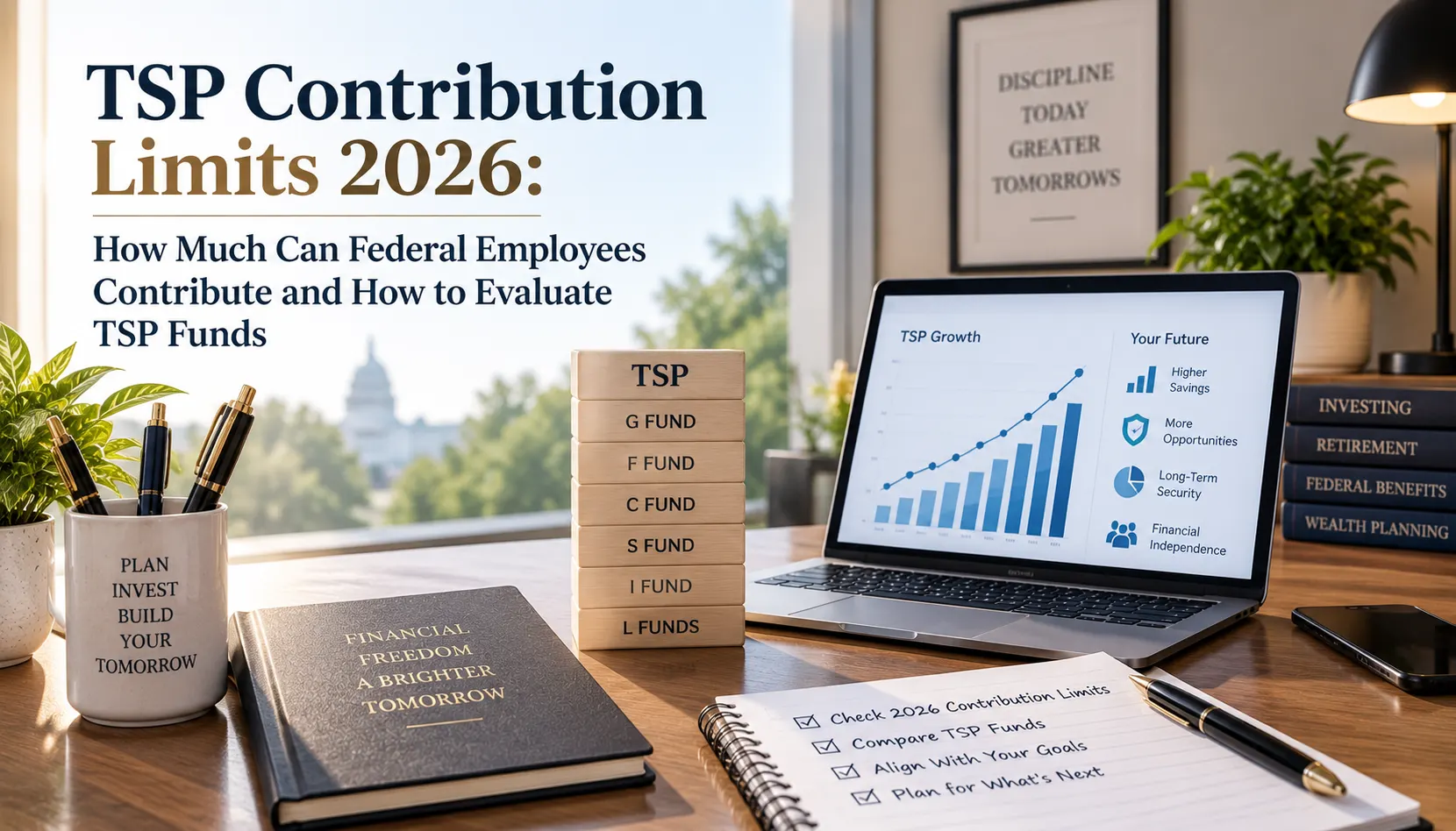
The Thrift Savings Plan (TSP) is an important retirement savings program for federal employees and members of the uniformed services. Understanding the annual TSP contribution limits, catch-up rules, agency contributions, and available investment funds can help you make more informed retirement planning decisions.
For 2026, the annual elective deferral limit for the TSP is $24,500. Participants age 50 and older may generally contribute an additional $8,000 in catch-up contributions. A higher catch-up limit of $11,250 applies to participants who attain age 60, 61, 62, or 63 during 2026, subject to applicable rules.
The right contribution amount and investment approach depend on your circumstances, retirement timeline, financial goals, and tolerance for investment risk.
Yes. The IRS increased the annual elective deferral limit for the federal government’s TSP from $23,500 in 2025 to $24,500 in 2026.
The 2026 limits include:
The enhanced catch-up applies for the calendar year in which an eligible participant turns 60, 61, 62, or 63.
These limits apply to employee elective deferrals and are separate from certain agency contributions.
Contributing more to your TSP can increase the amount available for retirement, but the appropriate contribution level depends on your income, expenses, other savings, and financial priorities.
For 2026, eligible participants can contribute up to $24,500 through regular elective deferrals.
Participants who qualify for catch-up contributions may be able to contribute more.
Before setting your contribution percentage, consider your cash flow and other financial obligations.
If you intend to contribute the maximum amount, spreading contributions across your pay periods can help you avoid reaching the annual employee contribution limit too early.
For example, a participant contributing $24,500 evenly over 26 pay periods would contribute approximately $942.31 per pay period.
Your actual payroll schedule and contribution percentage can affect the amount withheld.
For FERS employees, agency contributions can be an important part of TSP planning.
The standard FERS TSP structure includes:
This means contributing at least 5% of basic pay can generally allow an eligible FERS participant to receive the full agency matching contribution, subject to applicable rules.
Because agency contribution rules can vary by employment status and circumstances, review your current TSP and agency benefits information.
The TSP offers several investment funds with different objectives, risk characteristics, and investment exposures.
There is no single TSP fund that is automatically the “best” choice for every federal employee.
The C Fund invests in a stock index designed to track the performance of large U.S. companies.
It may be relevant to investors seeking long-term exposure to the U.S. stock market, but stock investments can experience significant price fluctuations.
The S Fund provides exposure to smaller U.S. companies outside the C Fund’s large-company universe.
Small- and mid-sized companies can have different risk and return characteristics than large companies. The S Fund can therefore behave differently from the C Fund.
The G Fund invests in special U.S. Treasury securities issued specifically for the TSP.
It is generally designed to provide preservation of principal and interest income while offering a different risk profile from stock and bond funds.
The F Fund invests in a broad U.S. bond index.
Bond investments can provide diversification compared with stock funds, but the F Fund is still subject to investment risks, including changes in interest rates and bond prices.
L Funds are target-date or lifecycle funds designed to provide diversified exposure across the TSP investment funds.
Their asset allocations are adjusted over time based on the fund’s target retirement horizon.
L Funds may be worth considering for participants who prefer a more diversified, professionally allocated approach rather than selecting individual TSP funds themselves.
There is no universally appropriate “best TSP fund.”
The appropriate investment mix can depend on factors such as:
A federal employee with several decades until retirement may have different investment considerations than someone approaching retirement.
Rather than choosing a fund solely because it recently performed well, consider how the fund fits into your overall financial plan.
Instead of relying on a single recommended allocation, consider several factors when reviewing your TSP.
Your investment horizon can influence how much market volatility you may be able to tolerate.
Stock funds can experience substantial short-term fluctuations. Investors should consider whether they can remain invested during periods of market decline.
Using multiple asset classes can help diversify a portfolio, although diversification does not eliminate investment risk.
Your FERS or CSRS benefits, Social Security, IRA accounts, other investments, and expected retirement expenses can all affect how you evaluate your TSP.
Your anticipated retirement withdrawals may also influence how you think about investment risk and asset allocation.
L Funds can be an option for participants who want a diversified investment approach that changes over time.
Rather than requiring you to manually adjust the allocation among the C, S, F, G, and other applicable TSP funds, an L Fund follows an investment allocation associated with its target time horizon.
However, choosing an L Fund is still an investment decision. Consider whether its allocation and risk level are consistent with your circumstances and retirement timeline.
TSP participants may have access to both Traditional TSP and Roth TSP contributions.
Traditional TSP contributions are generally made before federal income taxes are applied to the contribution. Taxes are generally paid when the money is distributed, subject to applicable rules.
Roth TSP contributions are made with after-tax dollars. Qualified Roth distributions can generally be tax-free if applicable requirements are satisfied.
The choice between Traditional and Roth contributions can depend on factors such as:
There is no single option that is appropriate for everyone.
Your TSP priorities can change as you move through your federal career.
Employees early in their careers may have a longer investment horizon and more time to recover from market declines.
Important considerations may include establishing regular contributions, understanding the agency match, and developing a diversified investment strategy.
Mid-career employees may want to review whether their contribution rate, investment allocation, and retirement savings are keeping pace with their goals.
This can also be a useful time to review FERS benefits, Social Security, and other retirement assets.
Employees nearing retirement may want to evaluate how their TSP fits with their FERS or CSRS pension, Social Security, expected expenses, healthcare costs, and other sources of income.
Investment risk and potential withdrawals may become increasingly important considerations as retirement approaches.
Not necessarily.
Contributing the maximum amount can be appropriate for some participants, but it may not be practical or suitable for everyone.
Before maximizing contributions, consider your:
For some employees, capturing available agency matching contributions may be an important first priority before increasing contributions further.
For employees covered by the Federal Employees Retirement System (FERS), TSP is one part of a broader retirement income picture.
FERS generally includes three major components:
Your retirement strategy may also include FEHB, FEGLI, IRAs, other investments, and personal savings.
Considering these pieces together can provide a more complete view of your potential retirement income.
The 2026 TSP elective deferral limit is $24,500. Participants who qualify for age-based catch-up contributions may contribute additional amounts. The standard age-50-and-over catch-up limit is $8,000, while the enhanced catch-up limit for eligible participants age 60 through 63 is $11,250.
A participant age 50 or older may generally contribute up to $24,500 in regular contributions plus an $8,000 catch-up contribution, for a potential total of $32,500. Eligible participants who attain age 60, 61, 62, or 63 during 2026 may have a higher catch-up limit of $11,250.
For participants who attain age 60, 61, 62, or 63 during 2026, the enhanced catch-up contribution limit is $11,250. Combined with the $24,500 regular contribution limit, this can allow up to $35,750 in employee contributions, subject to applicable rules.
The primary TSP investment funds include the G Fund, F Fund, C Fund, S Fund, and I Fund, along with Lifecycle (L) Funds that combine investments across available TSP funds.
There is no single best TSP fund for every participant. The appropriate choice can depend on your retirement timeline, risk tolerance, goals, other assets, and financial circumstances.
The C Fund provides exposure to large U.S. companies and can be part of a long-term investment strategy. However, it is a stock investment and can experience significant market fluctuations. Whether it is appropriate depends on your individual circumstances and overall investment strategy.
The G Fund may appeal to participants who prioritize principal preservation and stability. However, choosing the G Fund involves tradeoffs because its expected growth potential differs from stock-oriented funds.
An L Fund may be worth considering if you prefer a diversified investment approach that adjusts over time. The appropriate L Fund depends on your retirement timeline and whether its risk profile fits your circumstances.
Traditional and Roth TSP contributions receive different tax treatment. The appropriate choice can depend on your current and expected future tax situation, income, retirement timeline, and broader financial plan.
For eligible FERS employees, contributing at least 5% of basic pay can generally allow you to receive the full agency matching contribution. Your appropriate contribution rate may be higher or lower depending on your financial circumstances and retirement goals.
TSP decisions can involve more than choosing an investment fund.
Your contribution level, Traditional versus Roth contributions, investment allocation, retirement timeline, FERS pension, Social Security, taxes, and other assets may all be relevant to your overall retirement strategy.
Federal Employee Advisor Network helps federal employees and retirees connect with independent, licensed financial professionals who may be familiar with federal retirement planning and TSP considerations.
The professional you connect with can evaluate your individual circumstances and provide any personalized advice or recommendations directly to you.